An Encounter with Ransomware-as-a-Service: MEGAsync Analysis
Recon's SOC recently responded to an attempted ransomware and extortion attack. It had all the markings of a nightmare scenario
Andrew Cook
Insights
Eric Capuano ·
Archived article. Published in 2022; some details may be out of date.
As many in the industry are now aware, Okta experienced a form of security breach back in January which the wider industry was unaware of until screenshots obtained by the LAPSUS$ group were posted on Twitter on March 21st, at 10:15pm CDT.
The LAPSUS$ ransomware group has claimed to breach Okta sharing the following images from internal systems. pic.twitter.com/eTtpgRzer7
— Bill Demirkapi (@BillDemirkapi) March 22, 2022
What followed this storm on Twitter was a very vague statement from Okta posted on March 22 at 4:15am CDT, contents below.
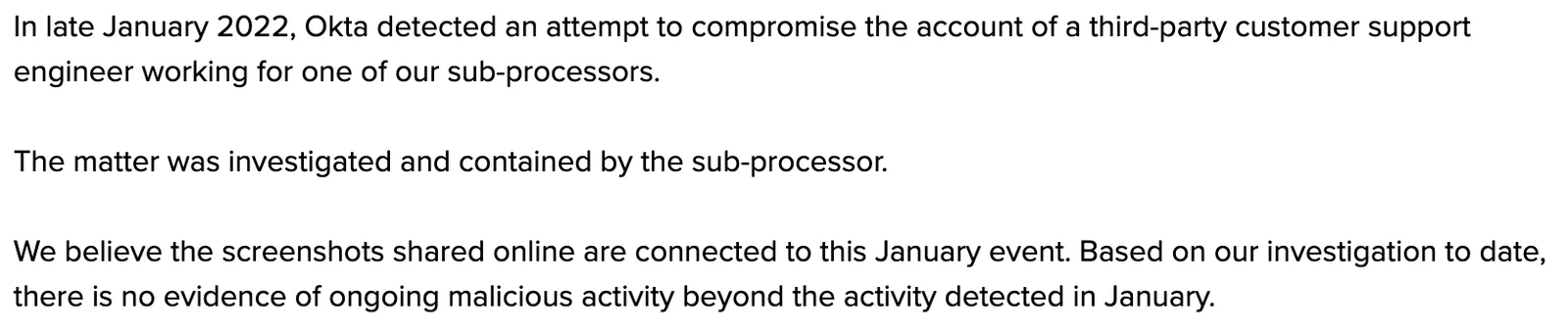
This left many wondering, what were the results of the “investigation to date” and why were customers not notified sooner?
In a follow-up statement from Okta on March 22 at 2pm CDT, additional information was given, but without answering these key questions.
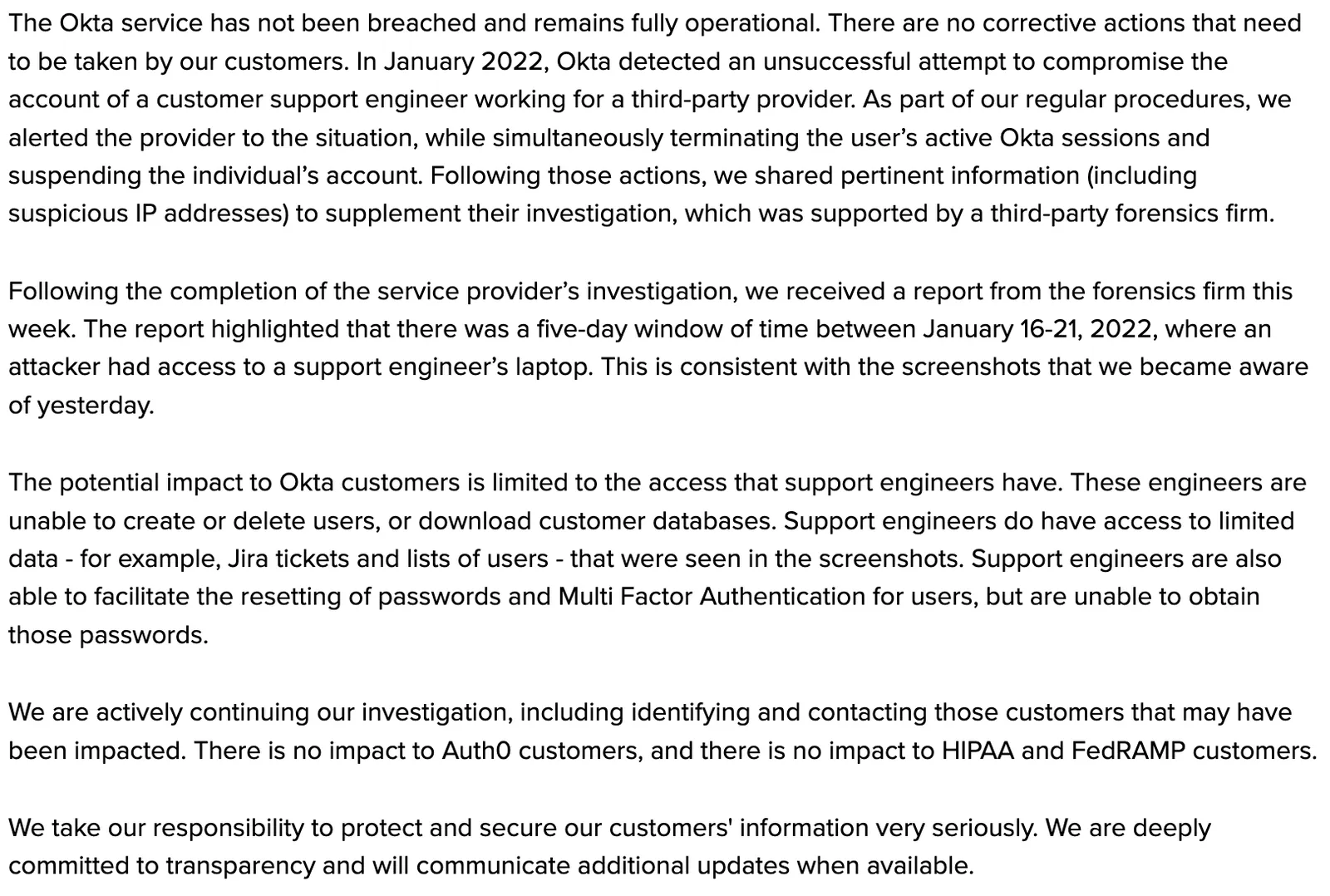
There are conflicting statements made such as “The Okta service has not been breached and remains fully operational” yet “there was a five-day window of time between January 16-21, 2022, where an attacker had access to a support engineer’s laptop…” While an attempt is made to down-play the implications of this access, “The potential impact to Okta customers is limited to the access that support engineers have. These engineers are unable to create or delete users, or download customer databases.” it is also clearly stated that “engineers are also able to facilitate the resetting of passwords and Multi Factor Authentication for users” which is quite enough access to do damage to an Okta customer environment. This is echoed in alleged refutations by LAPSUS$ to Okta’s statements.
Seems we weren’t the only ones left scratching our heads with these vague and contradicting statements…
There’s a lot in Okta’s statement that frankly doesn’t add up.
Meanwhile, Cloudflare (which uses Okta for its internal network, just like thousands of other orgs) says it found out just like everyone else — in the middle of the night from a tweet. https://t.co/rmewNxaDN2
— Zack Whittaker (@zackwhittaker) March 22, 2022
Like many other concerned organizations using Okta, we ignored the claim that “There are no corrective actions that need to be taken by our customers.” and began our own internal hunting and investigation. We are sharing the steps we took in hopes that it arms other organizations with the means to do the same.
Ideally, you are ingesting Okta logs into a SIEM or log aggregation tool, which makes this an easy task. Even if you are not, you can query Okta logs directly in the admin console. Here are some things that you can look for in your Okta system logs to identify suspicious activity.
Some events of interest include:
If you are familiar with the Sigma project, there are a collection of Sigma format rules specifically for Okta.
Some of the best guidance we’ve seen is compiled in this writeup from Cloudflare, but we’ll share a few additional thoughts.
While MFA alone cannot protect from a “superuser impersonation” threat, it is still a basic hygiene step that must be taken. Double-check that your Okta tenant enforces MFA for all user groups.
Ensure you are enforcing complex passwords for all users.
Consider password resets for any accounts that experienced a password change or MFA status change in the last ~3 months
Ensure that you are ingesting Okta logs to a SIEM or log aggregation tool that you control to ensure your retention reaches as far back as possible. For low-volume, high-value logs such as Okta authentication logs, it is not unreasonable to retain these for several years.
Leverage Okta’s HealthInsight tasks and recommendations to improve your Okta security.
Ensure that you have disabled Support access
Consider leveraging Okta’s Workflows feature to design notification webhooks around certain privileged activities.
An example of one such workflow we implemented:
With this example and several other workflows we’ve implemented, not only are these activities logged to our SIEM, but instant notification provided to the SOC as these events occur.
Okta has just made an updated statement about this incident which adds further clarity around what has happened.
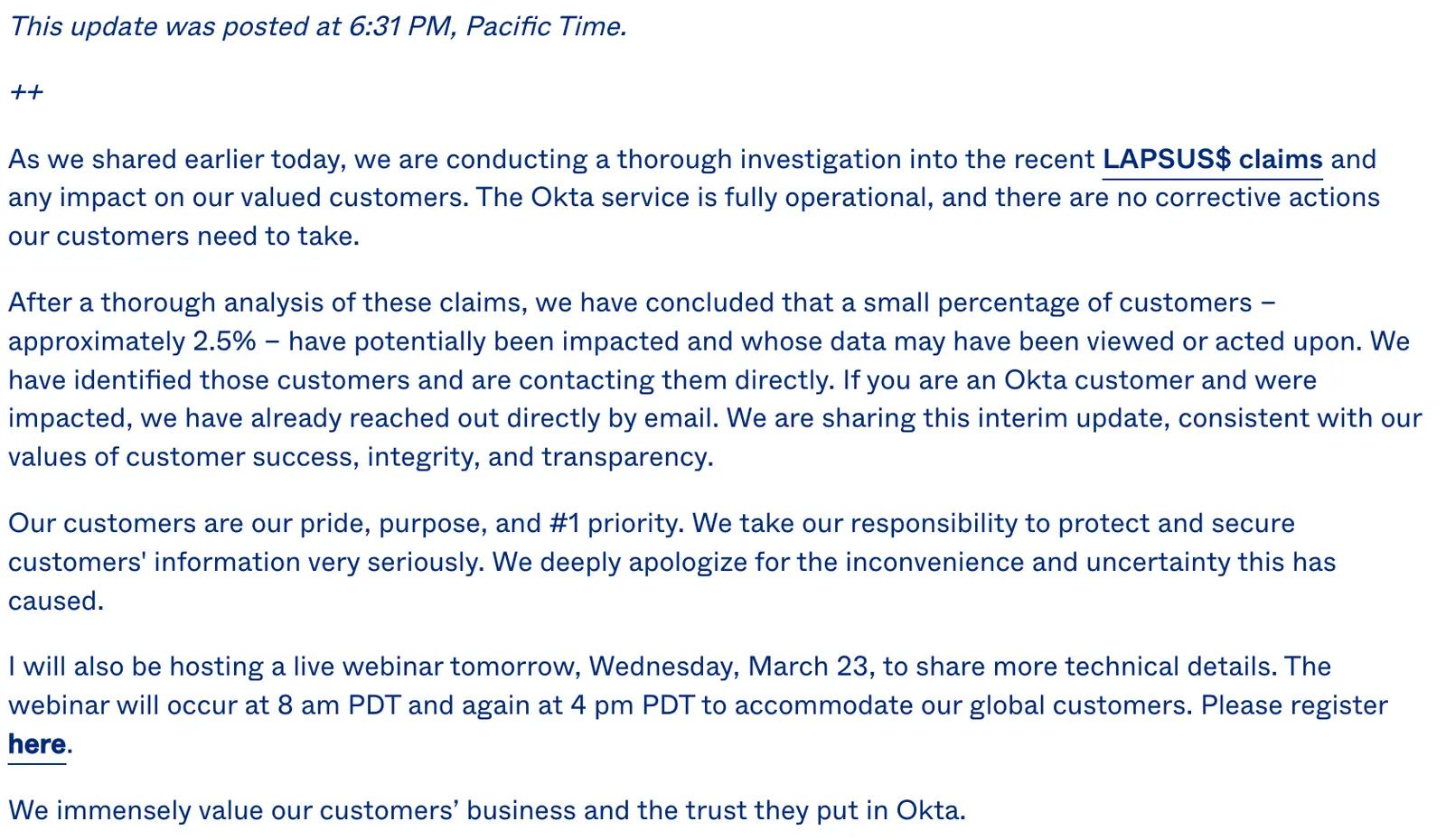
What is most concerning about this update is that it confirms there was, in fact, a breach involving Okta customer tenants.
we have concluded that a small percentage of customers – approximately 2.5% – have potentially been impacted and whose data may have been viewed or acted upon
According to public information, 2.5% of Okta’s user base could be nearly 400 organizations. This is a very different situation than was originally implied in the earlier statements from Okta, therefore our guidance above is even more important than before we knew the true scope of this.
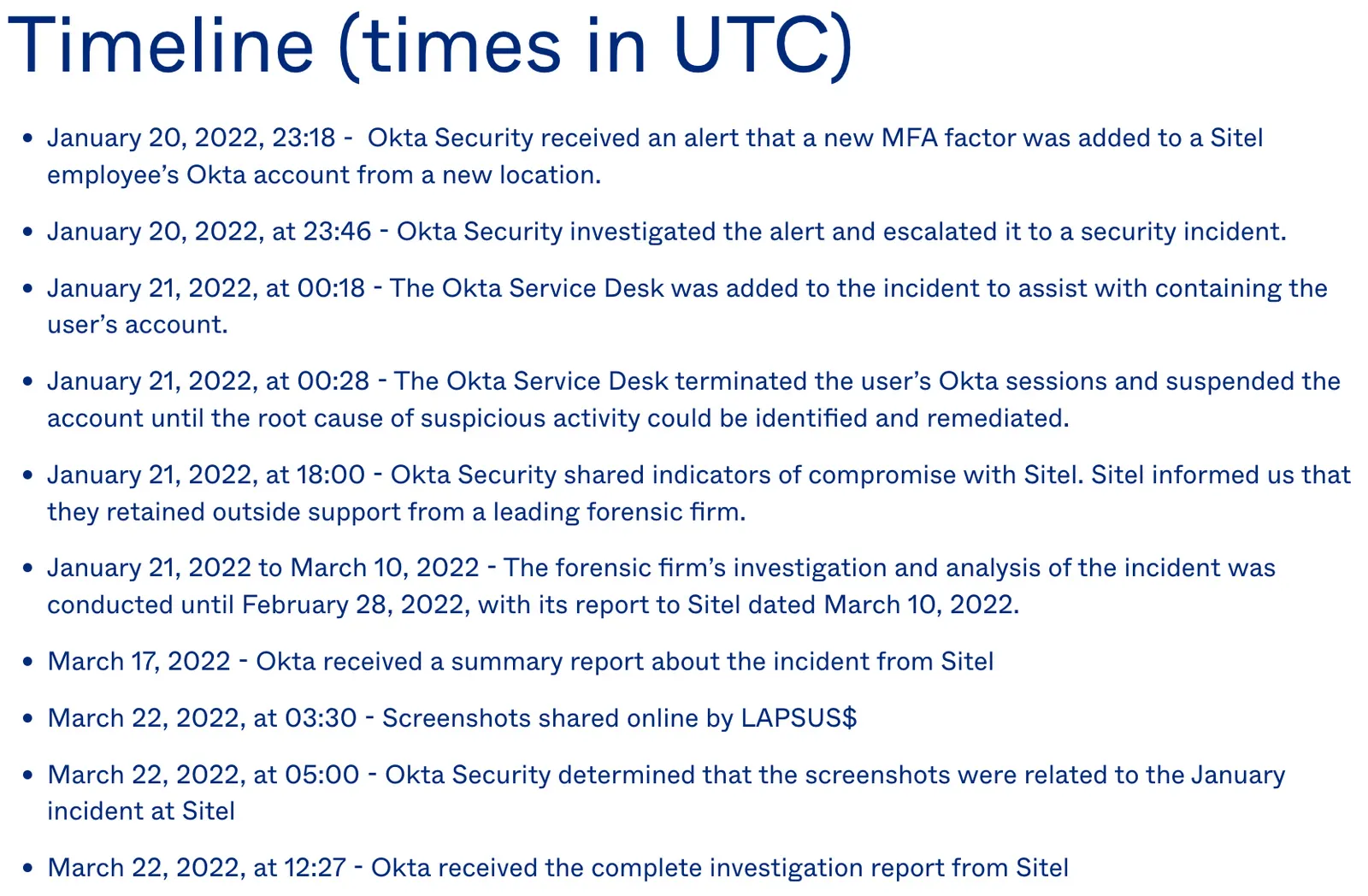
Okta has finally posted a proper timeline of events providing more detail about what happened and when.
Recon's SOC recently responded to an attempted ransomware and extortion attack. It had all the markings of a nightmare scenario
Andrew Cook
The Recon incident response team recently responded to a case of business email compromise.
Andrew Cook
The Recon incident response team recently worked an intrusion case involving a ManageEngine Desktop Central server that was affected by CVE-2020-10189.
Luke Rusten